
 Hair transplant surgery
Red Light Therapy After Hair Transplant: 7 Facts You Should Know
Red light therapy after hair transplant surgery is becoming an increasingly discussed option among patients who want to support hair growth and recovery. Also known as low-level light therapy (LLLT), this non-invasive treatment uses low-energy light to stimulate biological activity in the scalp. But does red light therapy actually help transplanted hair grow faster? Can it prevent shock loss, improve graft survival, or shorten recovery time?
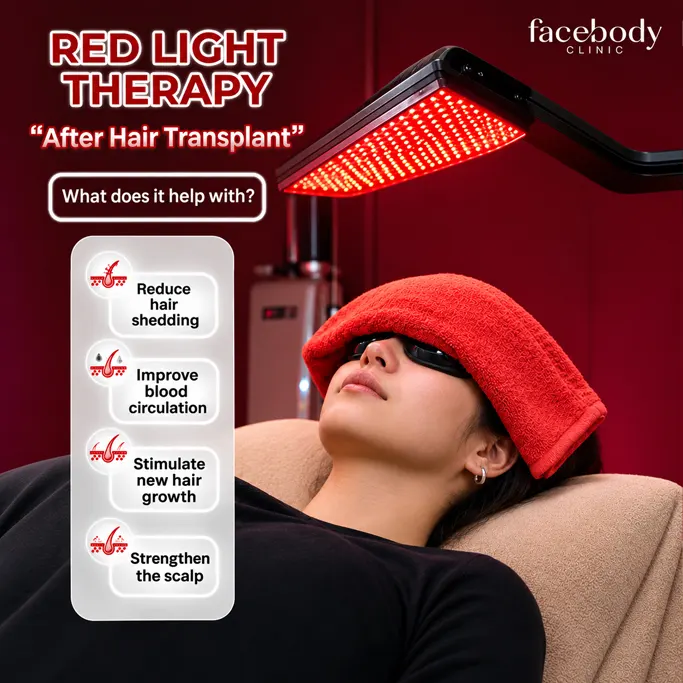
The short answer is that red light therapy is optional, not essential after a hair transplant. Research suggests that LLLT may improve hair density in some people with pattern hair loss. However, evidence that it improves hair transplant recovery or graft survival remains limited.
At Facebody Clinic in Bangkok, Thailand, we believe patients should understand the potential benefits, limitations, and safety considerations before choosing additional hair restoration treatments.
This guide explains seven important facts about red light therapy, including its effectiveness, timing, safety, and role in post-transplant care.
- 1. What Is Red Light Therapy After Hair Transplant Surgery?
- 2. Does Red Light Therapy After Hair Transplant Improve Hair Growth?
- 3. Can Red Light Therapy After Hair Transplant Prevent Shock Loss?
- 4. When Can You Start Red Light Therapy After Hair Transplant Surgery?
- 5. How Often Should You Use Red Light Therapy?
- 6. Is Red Light Therapy After Hair Transplant Safe?
- 7. Is Red Light Therapy Necessary After a Hair Transplant?
- Minoxidil
- Finasteride
- Platelet-Rich Plasma (PRP)
- Professional Hair Transplant Aftercare
- Red Light Therapy After Hair Transplant in Bangkok, Thailand
- Frequently Asked Questions About Red Light Therapy After Hair Transplant
- Does red light therapy after hair transplant really work?
- Can transplanted hair grow without red light therapy?
- Can I use a laser cap immediately after surgery?
- Does red light therapy prevent shock loss?
- Is red light therapy painful?
- How long does red light therapy take to show results?
- Should international patients buy an LLLT device before surgery?
- Conclusion: Should You Use Red Light Therapy After Hair Transplant Surgery?
- Medical References
1. What Is Red Light Therapy After Hair Transplant Surgery?
Red light therapy after hair transplant surgery involves exposing the scalp to specific wavelengths of low-energy light using specialized laser or LED devices. The treatment is also known as low-level laser therapy, low-level light therapy, or photobiomodulation.
Unlike surgical lasers, LLLT devices are not designed to cut or remove tissue. Instead, researchers believe that light energy may influence cellular activity associated with hair follicle function.
Some clinical studies have reported improvements in hair density among patients with androgenetic alopecia, commonly known as male or female pattern hair loss.
However, it is important to understand that LLLT does not create new hair follicles or replace surgical hair restoration.
Key takeaway: Red light therapy may support existing hair follicles in selected patients, but its effectiveness specifically after transplantation requires further research.
2. Does Red Light Therapy After Hair Transplant Improve Hair Growth?
One of the most common questions patients ask is whether red light therapy after hair transplant surgery can accelerate new hair growth. Research into LLLT for androgenetic alopecia has produced encouraging results in some studies, particularly regarding improvements in hair density.
A systematic review and meta-analysis indexed in PubMed discusses evidence relating to low-level laser and LED therapy for alopecia.
However, results from studies involving non-transplanted hair cannot automatically be applied to newly transplanted follicles.
Currently, there is insufficient high-quality evidence to conclude that LLLT consistently:
- Accelerates transplanted hair growth.
- Increases transplanted graft survival.
- Shortens the overall recovery period.
- Prevents post-operative hair shedding.
- Guarantees greater final hair density.
Hair transplant results depend on several factors, including surgical technique, donor hair characteristics, scalp health, graft handling, and appropriate aftercare.
Key takeaway: LLLT may benefit some patients with pattern hair loss, but faster transplanted hair growth is not guaranteed.
3. Can Red Light Therapy After Hair Transplant Prevent Shock Loss?
Shock loss refers to temporary hair shedding that can occur after hair transplantation. This shedding may affect transplanted hairs or existing hairs surrounding the treated area. Although it can be concerning, temporary shedding does not necessarily indicate transplant failure. Some hair restoration practitioners have explored red light therapy as a possible way to reduce post-operative shedding. However, there is not enough reliable clinical evidence to establish that red light therapy after hair transplant surgery consistently prevents shock loss.
Patients should also understand that shedding and regrowth are part of the recovery process for many hair transplant procedures.
If you experience unexpected or excessive shedding, contact your treating surgeon for an assessment.
Key takeaway: Red light therapy should not be considered a guaranteed solution for preventing shock loss.
4. When Can You Start Red Light Therapy After Hair Transplant Surgery?
The appropriate time to begin red light therapy after hair transplant surgery depends on individual healing progress, the surgical technique, and the device being used.
There is no universally accepted treatment schedule that applies to every patient.
Some clinics may provide supervised light therapy during recovery. However, at-home devices such as laser caps or helmets can make physical contact with the scalp.
Using these devices too early could cause unnecessary pressure or friction around healing grafts.
Before beginning treatment, make sure that:
- Your surgeon has approved the specific device.
- The recipient area has healed sufficiently.
- The device does not place pressure on healing grafts.
- There are no signs of infection or unusual inflammation.
- You understand the manufacturer’s safety instructions.
- Appropriate eye protection is used when required.
Patients should follow their surgeon’s individual aftercare instructions rather than relying on a generic online treatment schedule.
Key takeaway: Start LLLT only after your hair transplant surgeon confirms that it is appropriate.
5. How Often Should You Use Red Light Therapy?
Treatment frequency varies depending on the device, treatment protocol, and medical recommendation. Different LLLT devices may use different wavelengths, energy levels, and treatment durations. There is no single schedule that has been established as optimal for all hair transplant patients. More frequent treatment does not necessarily produce faster or better results.
If your surgeon recommends LLLT, follow the instructions for the approved device and avoid increasing treatment time without professional guidance.
Consistency may be important for certain LLLT protocols used to manage pattern hair loss, but this does not establish that more exposure improves transplant recovery.
Key takeaway: Use the treatment schedule recommended by your doctor and device manufacturer.
6. Is Red Light Therapy After Hair Transplant Safe?
Red light therapy after hair transplant surgery is generally considered a non-invasive treatment when appropriate equipment is used correctly.
However, it is not completely risk-free.
Potential concerns include:
- Temporary scalp irritation.
- Discomfort from device contact.
- Excessive pressure on healing areas.
- Eye exposure without appropriate protection.
- Use during an active scalp infection.
- Photosensitivity associated with certain medical conditions or medications.
- Patients should discuss any history of photosensitivity, scalp disorders, or relevant medication use with their doctor before beginning treatment.
Some hair-growth devices have received FDA clearance for specific indications. However, FDA clearance for a hair-growth device does not establish that it improves hair transplant outcomes.
For additional information, see the American Academy of Dermatology’s guide to red light therapy.
Key takeaway: Red light therapy may be appropriate for selected patients, but medical approval is particularly important during post-operative recovery.
7. Is Red Light Therapy Necessary After a Hair Transplant?
Red light therapy is not a mandatory part of every hair transplant recovery plan. Successful hair restoration involves appropriate surgical planning, careful graft handling, proper healing, and ongoing management of the underlying cause of hair loss. Depending on individual needs, a doctor may discuss other treatment options.
Minoxidil
Minoxidil is used to treat certain forms of hair loss and may help maintain or improve existing hair density. Patients who have undergone transplantation should ask their surgeon when topical treatment can safely be started or resumed.
Finasteride
Finasteride is a prescription medication commonly used to manage male pattern hair loss. It works by reducing dihydrotestosterone (DHT), a hormone associated with progressive follicle miniaturization. Finasteride can cause adverse effects and is not suitable for everyone. It must not be used during pregnancy.
Platelet-Rich Plasma (PRP)
PRP uses concentrated platelets obtained from the patient’s blood. It may be considered for selected patients, although treatment outcomes vary and it is not necessary for every hair transplant patient.
Professional Hair Transplant Aftercare
Following your surgeon’s post-operative instructions remains an essential part of recovery.
Appropriate scalp care, avoiding unnecessary friction, attending follow-up appointments, and reporting unusual symptoms are important regardless of whether additional treatments are used.
Key takeaway: Red light therapy is an optional complementary treatment rather than a replacement for standard medical aftercare.
Red Light Therapy After Hair Transplant in Bangkok, Thailand
Bangkok is a destination considered by international patients seeking hair restoration procedures. If you are traveling to Thailand for a hair transplant, your recovery plan should account for your individual healing progress, travel schedule, and access to follow-up care.
Before returning to your home country, discuss the following with your medical team:
- When you can safely resume normal hair care.
- Whether a laser cap or helmet is appropriate.
- When you may safely wear headwear.
- Which symptoms require medical attention.
- How follow-up appointments will be arranged.
- Whether additional treatments are necessary.
At Facebody Clinic in Thailand, patients can discuss their hair restoration goals and individual treatment considerations.
If you are considering red light therapy after hair transplant surgery, ask your treating surgeon whether it offers a meaningful benefit for your particular condition.
Frequently Asked Questions About Red Light Therapy After Hair Transplant
Does red light therapy after hair transplant really work?
LLLT may improve hair density in some patients with pattern hair loss. However, evidence that it consistently improves transplanted hair growth or graft survival is limited.
Can transplanted hair grow without red light therapy?
Yes. Red light therapy is not required for transplanted hair to grow. Appropriate surgical technique, healing, and follow-up care remain important.
Can I use a laser cap immediately after surgery?
Do not use a laser cap or helmet on the recipient area until your surgeon confirms that it is safe. Physical pressure or friction could interfere with healing.
Does red light therapy prevent shock loss?
There is insufficient evidence to guarantee that red light therapy prevents shock loss following hair transplantation.
Is red light therapy painful?
LLLT is generally non-invasive and well tolerated. However, device contact or scalp sensitivity during recovery may cause discomfort.
How long does red light therapy take to show results?
Studies involving pattern hair loss commonly evaluate outcomes over several months. There is no established timeline for additional benefits specifically involving transplanted hair.
Should international patients buy an LLLT device before surgery?
Not necessarily. Discuss the device with your surgeon before purchasing it, particularly if you plan to use it during the early recovery period.
Conclusion: Should You Use Red Light Therapy After Hair Transplant Surgery?
Red light therapy after hair transplant surgery may be worth discussing with your doctor, particularly if you also have existing pattern hair loss.
However, it should not be considered essential for every patient or promoted as a guaranteed way to accelerate hair growth, prevent shock loss, or improve graft survival.
The most appropriate recovery plan depends on your scalp condition, surgical procedure, medical history, and individual treatment goals.
If you are considering a hair transplant in Bangkok, Thailand, contact Facebody Clinic to discuss your hair restoration options and personalized aftercare plan.
Your hair restoration journey should be guided by medical evidence, realistic expectations, and professional advice.
Medical Disclaimer: This article is provided for educational purposes only and does not replace professional medical diagnosis, treatment, or advice from your hair transplant surgeon.